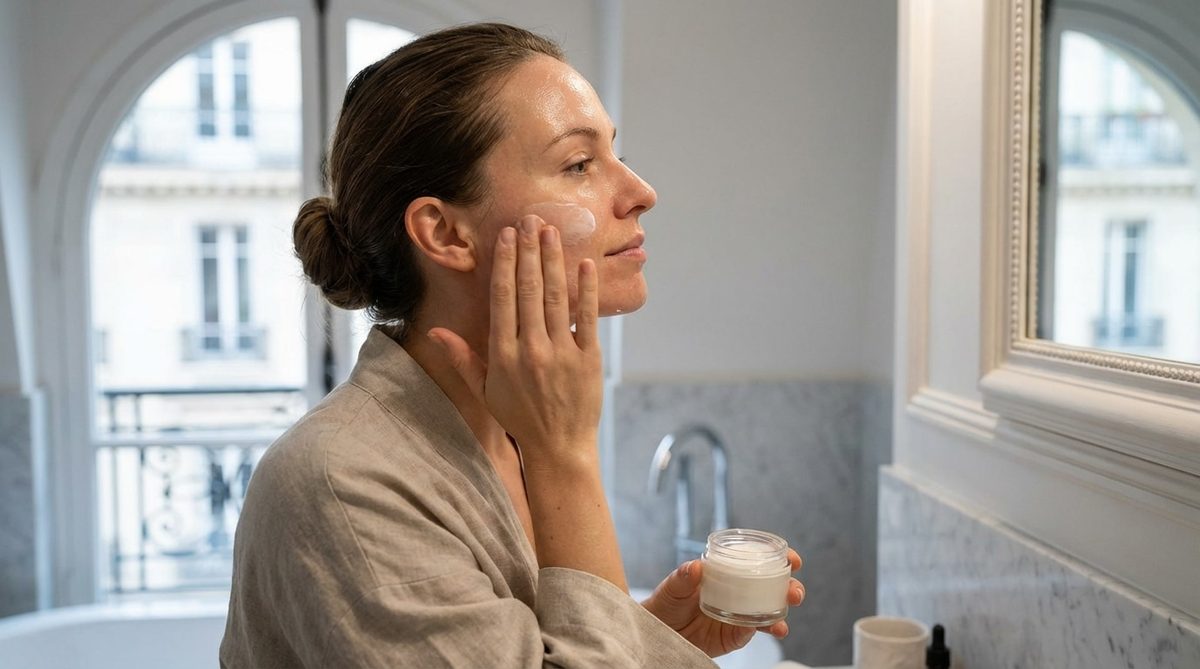
Morning skincare feels like a ritual. Wash your face. Pat dry. Apply moisturizer. It feels good.
This is also wrong.
Most of us let our skin dry completely before applying products. We think this is the most correct way to achieve it. This habit can hinder your efforts. Eliminates the need for expensive serums and high-quality packaging. It ignores basic physics.
Friction trap
We are particular about our ingredients. We choose natural ingredients. we recycle. We use cloth napkins. These are all good choices.
But then I got a terry towel. Massage vigorously. We want every drop of water to disappear.
This causes invisible micro-tears in the skin’s protective membrane. Friction can cause irritation. It causes hypersensitivity. The “moisture” of the water is actively removed. This is harmful.
Think houseplants. The summer is hot and the soil dries out. It was broken and hard. Pour water lost top. Water does not seep in and flows out the sides. The soil is too impermeable.
Your skin works the same way.
Applying the liquid to a completely dry surface prevents absorption. Antioxidants are lost. They evaporate. It’s a waste of money. It wastes energy.
60-second window
Activities have specific times.
It takes about 60 seconds of washing your face. This is the best window. Then transepidermal water loss begins. Natural moisture is lost in the air.
The solution is simple. Use skin care products when your skin is slightly damp. Not wet. humidity.
This small change changed everything. Increases the bioavailability of plant extracts. Helps the moisturizing complex work more effectively.
Consider a natural mushroom. A dry mushroom is hard. It hurts. It doesn’t absorb anything. Please water it first. Squeeze lightly. It’s soft now. It absorbs instantly.
Facial cells act like a sponge. The permeability increases when the spaces between the cells are filled with a thin layer of water. The door opened. Nutrients penetrate deeper. Every gram of product gives you more benefits.
How to adjust your morning routine
Stop wiping.
Start tapping.
Stop the vigorous scrubbing motion. This is an attack on the skin. Instead, press the towel against your face. Made of organic cotton and bamboo. Gently press the cheeks, forehead and chin for 2 seconds.
This removes excess water without drying out the skin barrier. Protects the delicate ecosystem of the skin.
You have to find the “perfect dew” level.
It takes a few days to get used to it. Too wet? The serum slides down the neck. It’s needlessly diluted. Is it too dry? I’m back to square one. The barrier remains closed.
Look in the mirror. I want some shine. Pearly light. There are no visible water drops on the chin. A transparent, quivering film of water.
This is the power of lasting beauty. This is where revival happens.
Leave the towel alone. Keeps the skin moisturized. Let the moisture do the hard work.
Has anyone checked in the mirror just now to see if it’s the right gloss?
The time between getting out of the shower and applying products is more than just routine time. This is an important biological threshold that determines whether skin care products are really effective or just dissolve from the skin. Most of us spend this time in the morning hurrying to dry and get dressed. But if you don’t want to waste your money on serums that no longer work, you need to understand the physics of wet skin.
Hyaluronic acid needs water
Hyaluronic acid is also known as the king of hydration because it can hold up to 1000 times its weight in water. It works like a magnet under water. But here’s the problem. When applied to dry skin, it cannot absorb moisture from the air. It brings it out from the deep layers of your own dermis. Molecules look for the nearest source of water. Reveals the internal reserves of the skin. It draws moisture to the surface where it evaporates. As a result, dehydration accelerates. Your skin will feel tighter and drier than before you started.
To solve this problem, you need to apply hyaluronic acid on damp skin. Spray your face with a mist or moisturizing cream. This molecule sticks to the surface of the water and holds it in place. Instantly replenishes your skin.
Ceramide offer
Attracting moisture is only half the battle. The other side is to prevent evaporation. If you don’t seal it, the moisture you saved will disappear with the spring breeze. This is where ceramides come into play. These are lipids that occur naturally in the skin’s barrier. By using thick creams and serums rich in ceramides and vegetable fatty acids, an occlusive layer is formed. Think of it like the lid of a microscope. It binds water in. This protection protects your skin from wind and environmental stress. This also means you use less product over time because you don’t have to constantly try to repair a damaged barrier.
If wet skin causes irritation
There are exceptions to the “use on wet skin” rule. Some ingredients are too strong for a damp skin. Chemical exfoliants such as retinol and AHA and BHA acids become dangerous in the presence of water. Water increases the permeability of these acids. Instead of gently renewing the skin, it penetrates deep into the tissues with great force. You may wake up red, scaly, or tingling.
Your skin must be completely dry for these treatments. Pat your face dry and wait 10 minutes. Let the water evaporate completely. Next, apply a retinol or acid. This slows absorption to a safe level. It produces results and prevents irritation.
Sunscreen hates moisture
Sunscreen is a great springtime ally, but it won’t be as effective if you apply it to damp skin. UV filters must form a uniform, continuous film on the surface of the skin. They must be combined into a radiation-blocking net. Water can interfere with this process. It causes rejection. The sunscreen layer slides off. A striped pattern appears. That leaves a gap in the cover. The end result is an incomplete shield that provides little protection against UV damage.
Applying sunscreen to damp skin can cause wrinkles. It looks pure white. It feels uneven. Requires a matte, dry surface. Wait until the moisturizer is completely absorbed. Wait until there is no water left. Then apply SPF sunscreen. This ensures that the SPF rating the bottle corresponds to the actual protection.
Exact steps for maximum absorption
Here’s how to time your post-shower ritual for best results. Don’t overthink it. Stick to your schedule.
- **Get out of the shower. ** Pat your skin lightly with a soft towel. Do not rub. Keep moist. It should look like dew.
- **Steps within 60 seconds. ** Apply a moisturizing serum or serum immediately. Massage until absorbed. The skin is still moist. Hyaluronic acid binds to water.
- Seal. Apply cream or oil containing ceramides immediately afterwards. It traps moisture before it evaporates.
- **Wait. ** Let’s go brush our teeth. I’m making tea. shampoo Allow the base coat to air dry. This will take about 5 minutes.
- ** Protection. ** When your face is dull and dry, apply a mineral or chemical sunscreen. The film is ready. The membrane forms correctly.
Significant changes in 3 weeks
This method does not require expensive products. It just takes timing. I’m not buying a new face cream. Changes the way existing resources are used. You will notice the changes within 3 weeks. Fine wrinkles caused by drying are softened. The skin becomes soft again. The skin’s protective flora returns to its functions. You may find yourself buying less and less products because your skin absorbs what you give it.
This is a change in efficiency. This is a way to adapt your everyday life to your body structure. Stop guessing. you start to know. The result is a naturally full and glowing face. It’s not because of heavy makeup. But since your barrier is intact.
So why wait? Next time you get out of the shower, check your watch. Moisturizes as long as the moisture remains. Let your skin breathe. See what happens when you stop using water barrier.