
Spring hits and suddenly your wardrobe feels like a trap. Heavy coats are still hanging there, blocking everything. Dresses come out, but they don’t fit right yet. You dig through piles of “basic” t-shirts just to find one that isn’t wrinkled or hidden under a sweater that doesn’t even fit anymore. It’s frustrating. You feel like you own everything and nothing at the same time.
The problem isn’t usually how many clothes you have. It’s how you use the space.
Most people think they need a complete wardrobe overhaul. They buy storage boxes. They hire organizers. They spend hundreds. But there is a simple trick that costs less than five euros. It doesn’t require throwing anything out. It just requires changing how you view empty air in your closet.
The Invisible Real Estate in Your Closet
A closet looks full when it’s actually suffocating. The air can’t move. You have clothes stacked so high that the bottom ones get crushed. You have shelves that are too high to reach, creating dead zones above them. You have the deep back of the shelf where things disappear into shadow.
This is where the “centimeters square” trap lives. You aren’t lacking space. You are lacking structure.
Without clear separators, everything merges into one chaotic pile. It looks tidy from a distance. It feels like a nightmare when you try to find a specific sock or a summer shirt. The goal isn’t to reduce your wardrobe. It’s to create “floors” within your existing space. You want verticality without the collapse.
The Under-Eight-Euro Solution: A Hanging Shelf Organizer
The fix is surprisingly small. It’s a hanging fabric organizer with shelves.
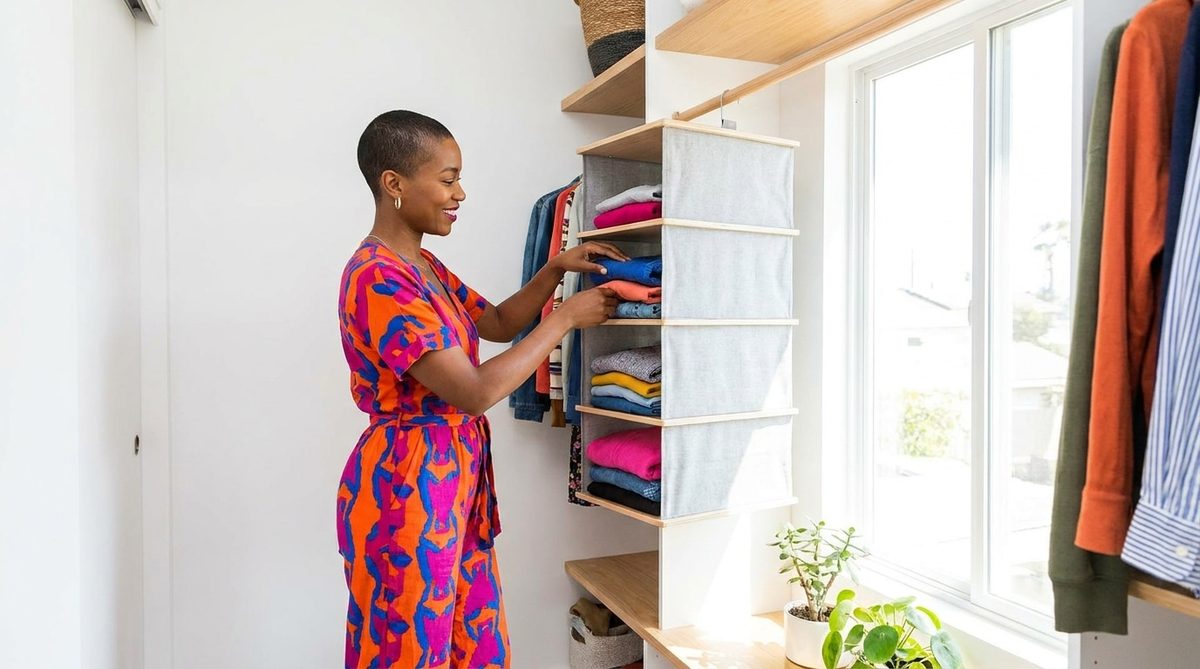
It clips onto your closet rod. It drops down like a curtain, but instead of blocking view, it creates vertical cases. One empty corner becomes a column of storage. You can slide shirts, folded jeans, or accessories into these pockets. The empty air above your hangers? Now it’s usable.
You can find these at discount stores, home goods sections, or even secondhand shops. The price is negligible. The impact is massive.
But don’t just grab the first one. The quality matters more than the design. Look for sturdy fabric. Check the stitching. If the material is too thin, the shelves will sag under the weight of your clothes. If the sides aren’t reinforced, the whole thing will look like a deflated balloon.
What to Avoid
Many people buy these and return them because they fail. Here is why.
Too narrow. If the pockets are tiny, you can’t fit a standard t-shirt or a pair of jeans. They become useless for anything other than belts.
Too flimsy. Soft fabric sags. Sagging shelves ruin the structure. You end up with a mess anyway.
Too many tiny cases. Some organizers have twelve small compartments. They are frustrating. You can only put small items in them. You end up with a cluttered display rather than organized storage.
Better to have fewer, well-sized compartments. You want pockets that can actually hold your clothes, not just your accessories.
How to Maximize This System
Once you hang it up, treat it like real furniture.
Use it for items you wear regularly but that don’t hang well. Jeans. Sweaters. T-shirts. Keep your hanging rod for coats and dresses that wrinkle easily. Let the organizer handle the folded stacks.
This isn’t about decluttering. It’s about layering your storage. You are adding a second floor to your closet without buying any furniture. You are using the vertical space that was just sitting there, doing nothing.
Try it for a week. See if you can find your favorite shirt in seconds instead of
The hidden mini diagnostic before hanging your organizer
Stop pulling out the tape measure for an hour. The goal isn’t precision; it’s survival. You need to check two things quickly: the clearance under the rod and the actual width available with the door closed. If your wardrobe door won’t shut properly because of a bulky storage unit, you’ve already lost. That daily friction is the start of unnecessary stress.
Next, sort by access, not value. The clothes you grab every morning need to stay in the prime real estate. Items you wear less often can move to the background, but keep them visible in designated slots so you don’t forget they exist. Finally, group by type. Without this step, your organizer becomes a giant purse for random junk. One slot, one family of items—jeans here, coats there—and your brain can finally exhale.
Install in under five minutes
Placement matters more than you think. Slide the unit to one side where it won’t rub against hanging hangers. You want fluid motion: pull a hanger, grab a sweater, close the door without a wrestling match.
Stability is the next hurdle. Put your heaviest items at the bottom. This lowers the center of gravity and prevents the unit from tipping. Avoid overstitching or overloading the seams. If it leans, either redistribute the weight or swap to a model with a stiffer base.
Height adjustment is everything. If there’s empty space above, raise the organizer. If the bottom drags on the floor or squashes the lowest shelves, lift it up. You need those bottom compartments to breathe.
How to fill it to double your space
Follow the golden rule: heavy at the bottom, light at the top. Jeans and thick knits in the lower bins. T-shirts and tanks in the middle. Scarves and delicate tops on the highest shelves. This logic prevents sagging and keeps the stack readable.
A simple distribution works wonders. Group sweaters by color or occasion. Fold jeans flat. Stand soft bags on their sides. Keep accessories in a dedicated slot. Do not cram them in. Tight packing isn’t always the friend you need. Aim for a neat, stable fold with a limited stack height. A shelf filled to 80% is far more practical than one bursting at the seams.
Zones that have changed roles
Once the hanging shelf organizer is in place, your static shelves regain a logical mission. That endless pile of unfolded clothes can migrate into the suspended cases, freeing up flat surfaces for bulky items that need room to breathe.
The hanging rod also unclutters without you giving anything away. Fewer layers on shelves mean more hanger space and significantly less wrinkling when you reach for something.
The real bonus? Time. When you can spot your outfit in seconds, the “search clutter” disappears. Less pulling, fewer collapsing piles, and a sudden sense that your closet is twice as big as it was yesterday.
The verdict after a few days
The most visible win is the reclaimed shelf space and the clarity of your stacks. Visually, the closet feels airier because you’ve finally utilized vertical height. Practically, your morning pieces are found without overturning the entire inventory.
To make it stick, you only need two tweaks: a seasonal rotation and a hard limit per bin. If a bin overflows, it’s a signal that your category is too broad, not that you lack space.
If you were to do this again, the ideal width depends on your closet size. In a small dressing, a narrower organizer avoids hanger interference. In a large walk-in, a wider model can replace an entire column of shelves.
By exploiting lost height and filling the system with simple logic, you change the dimension of your dressing space. No expensive purchases. No donating a single item. Is the ultimate luxury really just finding what you need in two moves, even when the season changes and everything starts to blend together?